
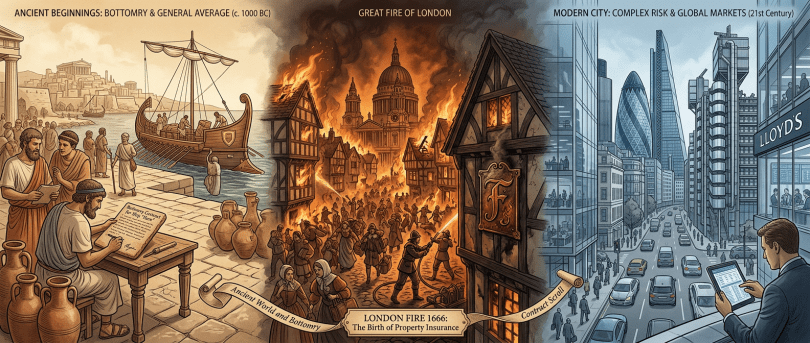
Three panels showing ancient, Great Fire of London, and modern city risk management scenes

From Shipwrecks to Safety Nets: The Origin of Insurance

Insurance did not begin in a boardroom. It began with fear.

Fear of losing a ship.
Fear of fire destroying a home.
Fear of a family starving after the death of the breadwinner.

And human beings eventually realized something powerful:

“One person alone may be ruined by disaster. But if many people share the risk together, nobody has to be destroyed.”

That simple idea became insurance.

The Earliest Form of Insurance — Ancient Traders

Thousands of years ago, merchants in places like ancient China and Babylon carried silk, spices, and grain across dangerous rivers and seas.

Ships sank. Bandits attacked. Storms destroyed cargo.

If one merchant lost everything, his family could become poor overnight.

So traders created a system:

  • Instead of putting all goods on one ship, they spread cargo across many ships.
  • Groups of merchants contributed money into a common pool.
  • If one person suffered a loss, the pool compensated him.

This was the seed of insurance.

One of the earliest written examples appears in the ancient Code of Hammurabi in Babylon around 1750 BCE. A merchant taking a loan for a sea voyage could pay an extra fee so the lender would cancel the debt if the shipment was lost.

That extra fee was basically an early insurance premium.

The Story Changes in London

The modern insurance industry truly took shape in 17th-century London.

Back then, London was crowded with wooden houses, candles, fireplaces, and narrow streets.

In 1666, disaster struck:
The Great Fire of London burned for four days.

More than 13,000 houses were destroyed.

People suddenly understood:

  • Fire can wipe out entire neighborhoods.
  • Rebuilding alone is impossible for most families.

After this tragedy, businesses began offering fire insurance. Homeowners paid regular amounts of money, and if their house burned down, the insurer helped cover the loss.

Some companies even created private fire brigades. Homes insured by a company displayed metal fire marks outside their houses so firefighters knew whom to help.

Shipping and the Birth of Big Insurance

At the same time, global trade was booming.

Ships traveled between Europe, Asia, and the Americas carrying tea, cotton, gold, and spices. But sea travel was extremely risky.

In a coffee house owned by Edward Lloyd, ship owners, merchants, and wealthy investors gathered to discuss voyages.

Investors would agree to cover portions of a ship’s risk in exchange for payment.

That coffee house eventually became Lloyd’s of London — one of the most famous insurance institutions in history.

The word “underwriter” comes from this practice because investors literally wrote their names under the risk agreement.

Life Insurance: A Different Kind of Protection

Eventually people asked a harder question:

“What happens to a family when a person dies?”

This led to life insurance.

At first, many people thought it was strange or even immoral to place money around death. But over time, society saw its value.

Life insurance became a way to protect widows, children, and families from financial collapse.

As cities industrialized during the 1800s:

  • factory accidents increased,
  • disease spread rapidly,
  • workers faced dangerous conditions.

Insurance expanded into:

  • health insurance,
  • accident insurance,
  • workers compensation,
  • automobile insurance,
  • business insurance.

Why Insurance Became Powerful

Insurance works because not everyone suffers loss at the same time.

For example:

  • out of 10,000 homes, only a small percentage may burn down each year,
  • out of millions of drivers, only some will have accidents,
  • many people pay premiums, but only a smaller group files claims.

This creates a financial safety net.

At its best, insurance allows people to:

  • start businesses,
  • buy homes,
  • travel,
  • build factories,
  • recover after disasters,
    without being completely ruined by one bad event.

Modern economies could not function without insurance.

Banks often will not issue mortgages without homeowners insurance. Businesses cannot operate major projects without liability coverage. Airlines, hospitals, shipping companies — all depend on insurance systems.

The Human Side of Insurance

At its core, insurance is really about collective survival.

It says:

“We cannot stop bad things from happening. But we can prevent one tragedy from destroying a person’s entire future.”

That is why the concept survived for thousands of years and became one of the foundations of modern civilization.

10 Cultural Habits That Might Surprise You: What’s Offensive in the U.S. But Normal in India

1. Directness and Honesty

  • In the U.S., being overly direct or blunt, especially when expressing negative opinions, can be considered rude or offensive. In India, people are often more indirect in communication, and being too blunt may not be as common, but being direct is generally not seen as offensive in the same way it might be in the U.S.

2. Pointing at People

  • Pointing directly at someone (whether with your finger or hand) can be considered impolite or offensive in the U.S. However, in India, it’s often seen as a casual gesture, especially when people are referring to something or someone in a crowd. It’s not always considered impolite in India.

3. Staring

  • In the U.S., staring at people can be seen as intrusive and rude. In India, however, especially in rural areas or among foreigners, people may glance or stare without it being seen as offensive. It’s a common, albeit culturally different, behavior.

4. Personal Questions

  • Asking personal questions about someone’s age, marital status, or income might be considered inappropriate or intrusive in the U.S. However, in India, such questions are often seen as part of regular conversation and are typically not seen as invasive or rude.

5. Respect for Elders

  • In India, it’s normal for younger people to touch the feet of elders as a sign of respect. This practice may seem odd or overly formal in the U.S. but is a deeply ingrained tradition in India, and it might not be understood or appreciated in the same way in the U.S.

6. Public Spitting

  • Spitting in public is generally viewed as offensive and unsanitary in the U.S. In India, especially in certain regions, public spitting (such as from chewing paan or betel) is still common, though it’s increasingly frowned upon in urban areas.

7. Chewing Gum Loudly

  • In the U.S., chewing gum loudly or popping it in public is often seen as impolite or childish. In India, it’s not uncommon to see people chewing gum in public, though it may be seen as a more casual or youthful behavior.

8. Informality in Addressing Elders or Strangers

  • In the U.S., it’s common to address even older individuals or authority figures by their first names, whether in casual or professional settings. This level of informality is widely accepted and not seen as disrespectful. In India, however, calling strangers, neighbors, or even older individuals by titles like “Aunty” or “Uncle” is a sign of respect, and using such terms for people you don’t know well in the U.S. might be considered overly familiar or inappropriate.

9. Touching Someone’s Head

  • In India, it is considered a sign of affection or respect to gently touch a child’s head. In the U.S., this gesture is often seen as intrusive or inappropriate, especially when it’s done by someone who isn’t close to the person.

10. Eating With Hands

  • In the U.S., eating with hands (except for certain foods like sandwiches or pizza) is generally considered unhygienic and impolite. In India, eating with hands, especially in traditional meals, is perfectly normal, and it’s often seen as a more intimate and respectful way to eat, especially with certain cultural and religious practices.

Best places for kids to visit during Chandigarh Visit

  1. Rock Garden: This unique garden, built entirely from industrial and home waste, is a fascinating place for kids to explore. The sculptures and structures made from recycled materials are sure to capture their imagination.
    • https://maps.app.goo.gl/GcuM2LYN7vN35uR37
    • The full name of the Rock Garden in Chandigarh is “Nek Chand’s Rock Garden.” It is named after its creator, Nek Chand Saini, who started building the garden secretly in 1957 using recycled materials and industrial waste. Today, it is one of the most popular tourist attractions in Chandigarh, known for its unique sculptures and structures made from recycled materials.
  2. Sukhna Lake: A serene place for a family outing, Sukhna Lake offers boating facilities which kids usually enjoy. The calm waters and surrounding greenery make it a pleasant spot for a leisurely day.
  3. Zakir Hussain Rose Garden: Kids can have a wonderful time amidst thousands of roses in this expansive garden. It’s a great place for a picnic or simply to stroll around and enjoy the beauty of the flowers.
  4. Chhatbir Zoo: Located near Chandigarh, Chhatbir Zoo is home to a variety of animals including lions, tigers, elephants, and more. It offers an exciting opportunity for kids to learn about wildlife and conservation.
  5. Leisure Valley: A long stretch of greenery in Chandigarh, Leisure Valley offers ample space for kids to play, run around, and enjoy outdoor activities. It’s a popular spot for family picnics and evening strolls.
  6. Museum and Art Gallery: The Government Museum and Art Gallery in Chandigarh houses a diverse collection of artifacts, paintings, and sculptures. It’s a great place for kids to learn about history, art, and culture.

These are just a few options, but Chandigarh has much more to offer in terms of recreational activities and entertainment for kids.