
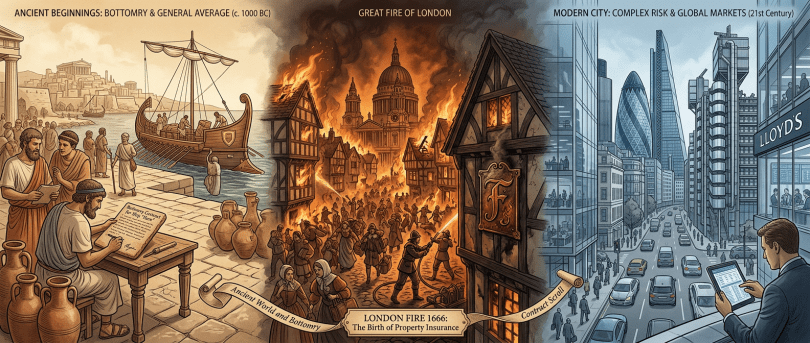
Three panels showing ancient, Great Fire of London, and modern city risk management scenes

From Shipwrecks to Safety Nets: The Origin of Insurance

Insurance did not begin in a boardroom. It began with fear.

Fear of losing a ship.
Fear of fire destroying a home.
Fear of a family starving after the death of the breadwinner.

And human beings eventually realized something powerful:

“One person alone may be ruined by disaster. But if many people share the risk together, nobody has to be destroyed.”

That simple idea became insurance.

The Earliest Form of Insurance — Ancient Traders

Thousands of years ago, merchants in places like ancient China and Babylon carried silk, spices, and grain across dangerous rivers and seas.

Ships sank. Bandits attacked. Storms destroyed cargo.

If one merchant lost everything, his family could become poor overnight.

So traders created a system:

  • Instead of putting all goods on one ship, they spread cargo across many ships.
  • Groups of merchants contributed money into a common pool.
  • If one person suffered a loss, the pool compensated him.

This was the seed of insurance.

One of the earliest written examples appears in the ancient Code of Hammurabi in Babylon around 1750 BCE. A merchant taking a loan for a sea voyage could pay an extra fee so the lender would cancel the debt if the shipment was lost.

That extra fee was basically an early insurance premium.

The Story Changes in London

The modern insurance industry truly took shape in 17th-century London.

Back then, London was crowded with wooden houses, candles, fireplaces, and narrow streets.

In 1666, disaster struck:
The Great Fire of London burned for four days.

More than 13,000 houses were destroyed.

People suddenly understood:

  • Fire can wipe out entire neighborhoods.
  • Rebuilding alone is impossible for most families.

After this tragedy, businesses began offering fire insurance. Homeowners paid regular amounts of money, and if their house burned down, the insurer helped cover the loss.

Some companies even created private fire brigades. Homes insured by a company displayed metal fire marks outside their houses so firefighters knew whom to help.

Shipping and the Birth of Big Insurance

At the same time, global trade was booming.

Ships traveled between Europe, Asia, and the Americas carrying tea, cotton, gold, and spices. But sea travel was extremely risky.

In a coffee house owned by Edward Lloyd, ship owners, merchants, and wealthy investors gathered to discuss voyages.

Investors would agree to cover portions of a ship’s risk in exchange for payment.

That coffee house eventually became Lloyd’s of London — one of the most famous insurance institutions in history.

The word “underwriter” comes from this practice because investors literally wrote their names under the risk agreement.

Life Insurance: A Different Kind of Protection

Eventually people asked a harder question:

“What happens to a family when a person dies?”

This led to life insurance.

At first, many people thought it was strange or even immoral to place money around death. But over time, society saw its value.

Life insurance became a way to protect widows, children, and families from financial collapse.

As cities industrialized during the 1800s:

  • factory accidents increased,
  • disease spread rapidly,
  • workers faced dangerous conditions.

Insurance expanded into:

  • health insurance,
  • accident insurance,
  • workers compensation,
  • automobile insurance,
  • business insurance.

Why Insurance Became Powerful

Insurance works because not everyone suffers loss at the same time.

For example:

  • out of 10,000 homes, only a small percentage may burn down each year,
  • out of millions of drivers, only some will have accidents,
  • many people pay premiums, but only a smaller group files claims.

This creates a financial safety net.

At its best, insurance allows people to:

  • start businesses,
  • buy homes,
  • travel,
  • build factories,
  • recover after disasters,
    without being completely ruined by one bad event.

Modern economies could not function without insurance.

Banks often will not issue mortgages without homeowners insurance. Businesses cannot operate major projects without liability coverage. Airlines, hospitals, shipping companies — all depend on insurance systems.

The Human Side of Insurance

At its core, insurance is really about collective survival.

It says:

“We cannot stop bad things from happening. But we can prevent one tragedy from destroying a person’s entire future.”

That is why the concept survived for thousands of years and became one of the foundations of modern civilization.

Insurance Exam – New Jersey

Insurance Exam Quick Summary (Numbered Points)

  1. Irrevocable Beneficiary
    • An irrevocable beneficiary designation prevents the policyowner from making any policy changes without the beneficiary’s written consent.
  2. Adverse Selection
    • Adverse selection is the tendency of higher-risk individuals to buy insurance more often than average-risk individuals.
  3. Consideration (Life & Health Insurance)
    • Consideration consists of statements made in the application and the premium paid.
  4. Insurable Interest
    • Insurable interest must exist only at the time of application, not at the time of claim.
    • If no beneficiary change occurs, the original beneficiary still receives proceeds.
  5. Policy Forms Responsibility
    • The insurance carrier (insurer) assembles policy forms, riders, and endorsements.
    • The producer may deliver the policy but does not assemble it.
  6. Dividends from Mutual Insurers
    • Dividends are not taxable because they are considered a return of excess premium, not income.
    • Mutual insurers may overcharge initially and refund surplus.
  7. Mutual vs Stock Insurers
    • Mutual insurer = Participating
    • Stock insurer = Non-participating
  8. Do Not Call Registry
    • Insurance sales calls are NOT exempt.
    • Political organizations, charities, and surveys are exempt.
  9. Fair Credit Reporting Act (FCRA)
    • Obtaining consumer reports under false pretenses:
      • Up to $5,000 fine and 1 year imprisonment (producer)
      • Federal maximum fines may reach $10,000 (individual) and $50,000 (corporation)
  10. Contract of Adhesion
    • Insurance contracts are prepared by the insurer with no negotiation.
    • Applicant must accept on a “take it or leave it” basis.
  11. Rating Service Companies
    • Their primary purpose is to determine an insurer’s financial strength.
  12. Law of Agency
    • The producer represents the principal (insurer).
    • Agents have actual, implied, and apparent authority.
    • The insurer is legally responsible for the agent’s actions.
  13. Implied Authority
    • Unwritten authority assumed necessary to conduct business on behalf of the insurer.
  14. Group Insurance Enrollment Period
    • The enrollment period is a limited time during which eligible members may sign up.
    • It cannot exceed four months.
  15. COBRA Continuation
    • Coverage remains the same.
    • Premium may increase to 102% of the prior premium.
    • Election must be made within 60 days.
  16. Preferred Provider Organization (PPO)
    • Out-of-network care is covered, but at a lower percentage.
    • If care is outside the network with no coverage, insured may pay 100%.
  17. Suicide Clause (Life Insurance)
    • If suicide occurs within the stated period:
      • Insurer refunds premiums paid minus indebtedness
      • No interest is paid
  18. Group Disability Income Insurance
    • Covers non-occupational illnesses and injuries.
    • Occupational injuries are covered by workers’ compensation.
  19. Annuities
    • Only the policyowner can surrender an annuity during accumulation.
    • Refund annuity returns the remaining value if annuitant dies during payout.
    • Fixed Period Option:
      • Payments made for a set time
      • Beneficiary chooses the time period, not the amount
      • If beneficiary dies, remaining payments go to estate or contingent beneficiary
  20. Indexed Annuities
    • Interest is tied to a market index (commonly S&P 500).
    • Subject to caps, floors, or participation rates.
  21. Unearned Premium
    • Unearned premium belongs to the insured, not the insurer.
  22. Alien Insurance Company
    • Chartered and organized in a country outside the United States.
  23. New Jersey Licensing & Compliance
    • CE Requirement: 24 hours every 2 years, including 3 ethics hours
    • Temporary Certificate validity: 60 days
    • Branch office registration: 30 days before opening
    • Closing a branch office: Notify within 30 days
    • Producer must notify DOBI within 30 days of:
      • Address changes
      • Administrative actions
  24. Policy Delivery
    • Individual policy or certificate must be delivered:
      • At effective date or
      • Within 30 days
  25. Medicare Rules
    • Medicare qualifying events do NOT include being poverty-stricken.
    • Medicare Advantage (Part C) enrollment occurs when eligible for Medicare.
    • Medicare Supplement can be canceled for nonpayment.
    • If age 65+ and working for an employer with 20+ employees:
      • Employer plan is primary
      • Medicare is secondary
  26. Alcoholism Coverage
    • Group health-care service contracts must cover treatment for alcoholism.
  27. Disability Income Insurance
    • Designed to replace a portion of income during disability.
    • Does not replace full income or pay medical expenses.
  28. Subrogation
    • Allows the insurer to recover money from a third party responsible for the loss after paying a claim.
    • Prevents double payment and helps control premiums.

Always add insurance option while buying Travel Tickets

Referring to the article on ET people who were affected by the Balasore Train accident could have got some solace if they had paid the extra 35 paise as a part of insurance while buying the tickets. They would have got death benefit of 10 lakh, permanent disability 10 lakh, hospitalization coverage 2 lakh and Transportation of mortal remains INR 10,000. So this is just one example and one case.

How often do we select that insurance option while booking tickets? Now that we know about it we can definitely add this extra few paise or rupees while buying a train ticket or bus ticket. But most often for flight tickets the insurance part would be more. So we might not choose that option. But remember risk is also more while flying. So better to opt for that every time that option is there. Now we need to cross check of all the people who opted for that how many get the benefit and how soon. Because the family members might not even be aware if they had opted for that or not!! Not everyone buys tickets online. Hope Government compensates everyone affected by the accident.