
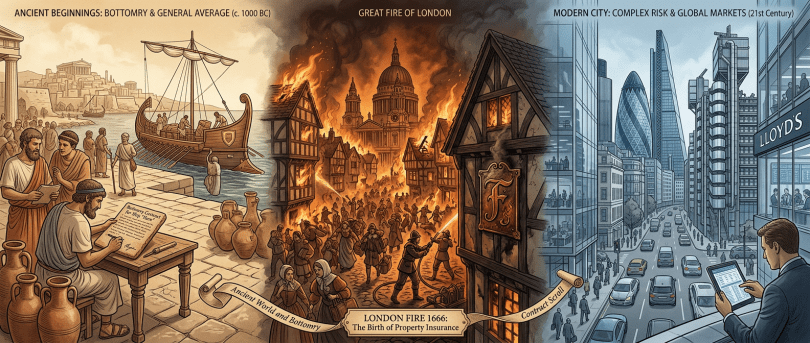
Three panels showing ancient, Great Fire of London, and modern city risk management scenes

From Shipwrecks to Safety Nets: The Origin of Insurance

Insurance did not begin in a boardroom. It began with fear.

Fear of losing a ship.
Fear of fire destroying a home.
Fear of a family starving after the death of the breadwinner.

And human beings eventually realized something powerful:

“One person alone may be ruined by disaster. But if many people share the risk together, nobody has to be destroyed.”

That simple idea became insurance.

The Earliest Form of Insurance — Ancient Traders

Thousands of years ago, merchants in places like ancient China and Babylon carried silk, spices, and grain across dangerous rivers and seas.

Ships sank. Bandits attacked. Storms destroyed cargo.

If one merchant lost everything, his family could become poor overnight.

So traders created a system:

  • Instead of putting all goods on one ship, they spread cargo across many ships.
  • Groups of merchants contributed money into a common pool.
  • If one person suffered a loss, the pool compensated him.

This was the seed of insurance.

One of the earliest written examples appears in the ancient Code of Hammurabi in Babylon around 1750 BCE. A merchant taking a loan for a sea voyage could pay an extra fee so the lender would cancel the debt if the shipment was lost.

That extra fee was basically an early insurance premium.

The Story Changes in London

The modern insurance industry truly took shape in 17th-century London.

Back then, London was crowded with wooden houses, candles, fireplaces, and narrow streets.

In 1666, disaster struck:
The Great Fire of London burned for four days.

More than 13,000 houses were destroyed.

People suddenly understood:

  • Fire can wipe out entire neighborhoods.
  • Rebuilding alone is impossible for most families.

After this tragedy, businesses began offering fire insurance. Homeowners paid regular amounts of money, and if their house burned down, the insurer helped cover the loss.

Some companies even created private fire brigades. Homes insured by a company displayed metal fire marks outside their houses so firefighters knew whom to help.

Shipping and the Birth of Big Insurance

At the same time, global trade was booming.

Ships traveled between Europe, Asia, and the Americas carrying tea, cotton, gold, and spices. But sea travel was extremely risky.

In a coffee house owned by Edward Lloyd, ship owners, merchants, and wealthy investors gathered to discuss voyages.

Investors would agree to cover portions of a ship’s risk in exchange for payment.

That coffee house eventually became Lloyd’s of London — one of the most famous insurance institutions in history.

The word “underwriter” comes from this practice because investors literally wrote their names under the risk agreement.

Life Insurance: A Different Kind of Protection

Eventually people asked a harder question:

“What happens to a family when a person dies?”

This led to life insurance.

At first, many people thought it was strange or even immoral to place money around death. But over time, society saw its value.

Life insurance became a way to protect widows, children, and families from financial collapse.

As cities industrialized during the 1800s:

  • factory accidents increased,
  • disease spread rapidly,
  • workers faced dangerous conditions.

Insurance expanded into:

  • health insurance,
  • accident insurance,
  • workers compensation,
  • automobile insurance,
  • business insurance.

Why Insurance Became Powerful

Insurance works because not everyone suffers loss at the same time.

For example:

  • out of 10,000 homes, only a small percentage may burn down each year,
  • out of millions of drivers, only some will have accidents,
  • many people pay premiums, but only a smaller group files claims.

This creates a financial safety net.

At its best, insurance allows people to:

  • start businesses,
  • buy homes,
  • travel,
  • build factories,
  • recover after disasters,
    without being completely ruined by one bad event.

Modern economies could not function without insurance.

Banks often will not issue mortgages without homeowners insurance. Businesses cannot operate major projects without liability coverage. Airlines, hospitals, shipping companies — all depend on insurance systems.

The Human Side of Insurance

At its core, insurance is really about collective survival.

It says:

“We cannot stop bad things from happening. But we can prevent one tragedy from destroying a person’s entire future.”

That is why the concept survived for thousands of years and became one of the foundations of modern civilization.
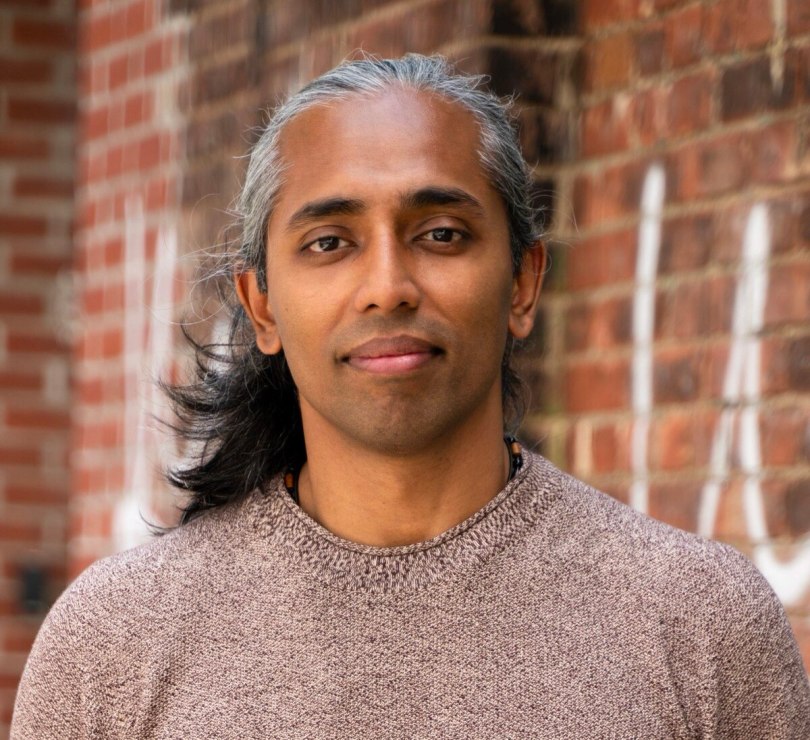
Mo Shaikh

Who Is Mo Shaikh?

Mohammad “Mo” Shaikh is an influential American entrepreneur, investor, and policy strategist who works in blockchain, Web3, and traditional finance.
(Birth year: publicly available sources list him as born in 1986.)
He was raised in Brooklyn by immigrant parents from Pakistan — his father worked as a taxi driver, and his mother was a homemaker. (He is described as having immigrant parents because both of them moved from Pakistan to the United States before he was born.)
Mo’s childhood experiences helped shape his mission: to create a financial system that is fair and accessible for everyone.


Early Life & Education

Mo earned a Bachelor of Science degree in Economics, Psychology, and Accounting from Hunter College.

He later received an MBA in Organizational Strategy & Finance from the Simon Business School at the University of Rochester.

While in business school, he was very active in student leadership. He served as co-president of the Investment Club and also helped run a student venture fund.


Career Trajectory

Traditional Finance

Before entering the blockchain world, Mo worked in private equity (including time at BlackRock) and in strategy consulting at the Boston Consulting Group (BCG).

He advised clients in the energy, telecom, and sovereign-wealth sectors.


Blockchain & Web3

Meridio

In 2017, Mo co-founded Meridio, a ConsenSys-backed platform used to tokenize real estate on Ethereum.

One of Meridio’s early achievements was fractionalizing ownership of a Brooklyn property at 304 Troutman Street using blockchain.

Meridio was later merged into ConsenSys.

Aptos Labs

In 2021, after Meta (Facebook) shut down its Diem blockchain, Mo and engineer Avery Ching founded Aptos Labs.

Under Mo’s leadership, Aptos raised nearly $500 million from top investors such as a16z, Apollo, and BlackRock.

Aptos also built partnerships with companies like Google Cloud, Microsoft, NBCUniversal, and major global asset managers.

The company expanded worldwide — including into Asia — through moves like acquiring the Japanese firm HashPalette.

In December 2024, Mo stepped down as CEO of Aptos, but he remained a founding shareholder.

Investing & Advising

After leaving his CEO role, Mo shifted into supporting and mentoring early-stage Web3 and AI founders.

Venture Fund

In 2025, he co-founded Maximum Frequency Ventures (MFV), a $50 million fund focused on crypto infrastructure, Web3 innovation, and AI networks.


Policy & Governance

Mo was appointed to the CFTC Digital Assets Subcommittee in 2024.

He also serves on the board of trustees at Hunter College.

He frequently speaks at major global conferences — including the World Economic Forum, Milken Institute, and Point Zero Forum — where he discusses financial inclusion, regulation, and the future of blockchain.


Motivations & Philosophy

Mo’s early life, especially watching his parents struggle with traditional financial systems, inspired him to rethink how money should move in the modern world.

He believes blockchain can remove inefficiencies, helping transactions become faster, cheaper, and more transparent.

His work connects traditional finance with crypto innovation, aiming to bring Web3 technology into everyday use.


Impact & Legacy

Under Mo’s leadership, Aptos quickly became a major Layer-1 blockchain with a strong developer community and many institutional partners.

His work at Meridio helped pioneer tokenized real estate and showed how real-world assets can be shared more fairly using blockchain.

Through policy work, investing, and leadership, Mo continues to influence both the technology and regulation of digital assets.


Challenges & Critiques

Like many blockchain leaders, Mo and Aptos have faced questions about tokenomics and funding transparency.

There are also natural questions about how a founder stays influential after stepping away from a CEO role — but Mo’s launch of MFV shows that he is continuing to build in the space.


What’s Next

Growing MFV

Through his venture fund, Mo will likely invest in companies focused on crypto infrastructure, AI systems, and tools connecting blockchain with real-world use.

Policy Influence

His role in regulatory discussions may help shape how governments around the world treat digital assets.

Web3 in Emerging Markets

Mo has highlighted huge opportunities in regions like Asia and the Middle East, where older financial systems are less efficient and Web3 could help more people gain access to modern technology.


Final Thoughts

Mo Shaikh is more than a tech founder. He is someone who wants to make the financial world easier and fairer for everyone. Growing up in Brooklyn with immigrant parents taught him how difficult money and banking can be for ordinary people.

Because of that, he has spent his career trying to build better financial tools using new technology. His work at Aptos, his early real-estate blockchain projects, and now his investing and policy work all show the same goal:
help people, open more doors, and make the financial system work for everyone.

Reference

https://www.moshaikh.com/

https://cryptonews.com/news/aptos-labs-ceo-mo-shaikh-resigns/?utm_source=chatgpt.com

Beginner-friendly roadmap for your $500 trading account

Here’s a beginner-friendly roadmap for your $500 trading account — structured so you learn the basics, manage risk, and gradually understand higher-return strategies, without getting overwhelmed.


1️⃣ Start with the Right Markets

Focus on markets that are low-cost to enter, liquid, and beginner-friendly:

MarketWhy Start HereNotes
StocksEasy to understand; small investments possible; foundational for learning trading psychologyUse fractional shares if $500 isn’t enough for full shares
OptionsGood for learning leverage and hedging; small contracts can be affordableStart with basic calls/puts, avoid complex spreads initially
ForexAccessible for small accounts; 24/5 trading; good for learning price actionStart with micro-lots, demo trading first
BondsSafe, long-term learning, but less relevant for active trading with small capitalOptional for now
FuturesSkip initially; high leverage is risky with $500Learn later after gaining experience

2️⃣ Focus on Key Strategies

These strategies teach trading discipline, risk control, and market awareness:

StrategyWhy It MattersBeginner Tip
Risk ManagementProtects your small capital; prevents big lossesAlways use stop-losses; risk ≤ 1-2% per trade
Portfolio BuildingLearn diversification even with small capitalSpread $500 across 2–3 trades, don’t put all in one
SpeculationUnderstand short-term price movesStart with demo trading first to test patterns
Portfolio HedgingProtects positionsLearn simple hedging later using options
Capital EfficiencyMaximizes returns with small fundsAvoid over-leveraging; focus on high-probability trades
Active Wealth ManagementTracking and adjusting tradesKeep a trading journal to learn from mistakes

3️⃣ Tools to Learn First

  • Candlestick charts: Read market psychology, trend reversals, and entry/exit points
  • Support & Resistance Levels: Identify where prices might bounce or reverse
  • Volume Analysis: Understand strength behind price moves
  • Simple Technical Indicators (optional initially): Moving averages, RSI, MACD — for confirming trends

4️⃣ Practical Learning Path

  1. Start with demo accounts: Practice Stocks and Forex using candlestick charts and basic technical analysis
  2. Learn risk management: Decide your maximum loss per trade (e.g., 1–2% of $500 = $5–$10)
  3. Begin small: Place real trades with $50–$100 at first
  4. Track everything: Keep a journal — note entry, exit, reasoning, mistakes, and lessons
  5. Gradually expand: Learn Options after you’re comfortable with basic price action
  6. Optional: Later explore dividend strategies, hedging, and more advanced portfolio techniques

💡 Summary for Your $500 Start

  • Focus on Stocks, Forex, and basic Options
  • Learn Risk Management, Portfolio Building, Candlestick Patterns, and Capital Efficiency
  • Avoid complex strategies (Futures, large-scale hedging) until you gain experience
  • Always start small and track your trades

With the help of #chatgpt 🙂